
Course Overview - Note: this training course is fully enrolled. Contact for alternatives.
This course is designed for Gynecologists who want to transform their surgical skill and confidence by developing the ability to reliably suture and tie knots laparoscopically.
Course Goals
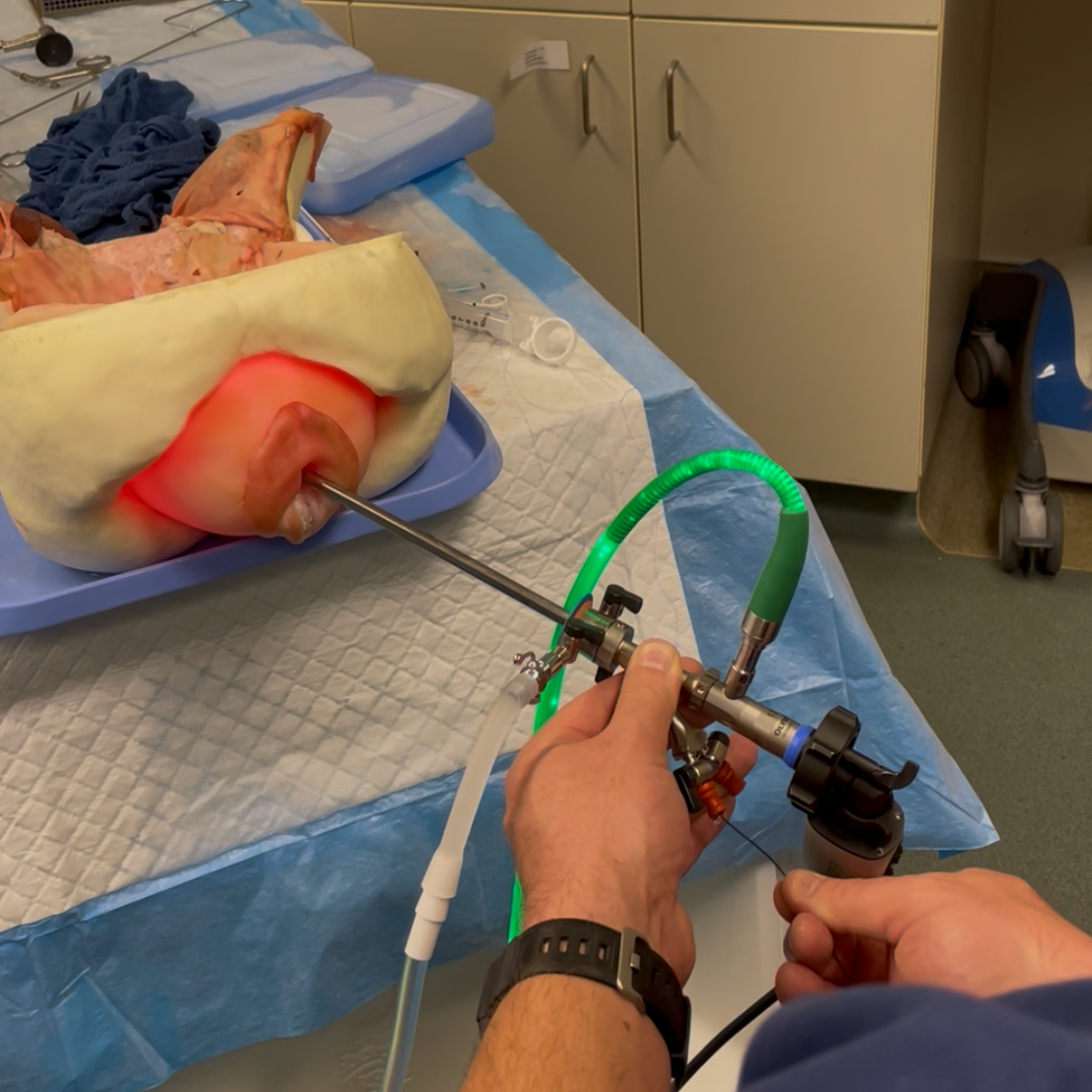
1) Demonstrate complete and accurate assembly of cystoscope including irrigation setup.
2) Demonstrate safe introduction of cystoscope (male and female anatomy).
3) Demonstrate thorough evaluation of the entirety of endoluminal surface of bladder.
4) Demonstrate recognition of bladder cancer gross morphologies.
5) Demonstrate safe and effective simple biopsy procedure.
6) Demonstrate reproducible method/technique for identification of ureteric orifices.
7) Demonstrate Bilateral 5 Fr ureteral stent placement with guideware.
8) Demonstrate Bilateral 5 Fr ureteral stent placement with guidewire and injection of contrast agent for retrograde pyelogram or ICG.
9) Demonstrate Bilateral 6 Fr double J stent placement with stabilization of retrieval sutures.Course Schedule & Curriculum.
Friday, September 25, 2026
Individual Sessions 1.5 hrs (2 attendee per session):
Session #1: 8:30am to 10:00am
Session #2: 10:15 am to 11:45 am
Session #3: 12:00pm to 1:30 pm
Dry Lab Procedural Stations:
Cystoscope assembly, sensor guidewire placement, 5 Fr open stent placement over wire, securement of stents.
Cystoscope assembly, sensor guidewire placement, 5 Fr open stent placement over wire, injection of contrast.
Cystoscope assembly, sensor guidewire placement, 6-22(24,26) double J stent placement over wire with stent pusher.
Real Tissue Model Procedural Stations:
Female genitalia, bladder, ureters model supporting diagnostic cystoscopy and identification of bilateral ureteric orifices with placement of guidewire and open ended stent and simple biopsy of endothelial lesion. (2)
Female bladder, ureters and kidney models supporting performance of cystoscopy and bilateral open ended stent placement, bilateral open ended stent placement with contrast injection, bilateral Double J stent placement. (2)
Note: course registration is now full. Please contact info@gynesim.com or malcolmmackenzie@gynesim.com with direct inquiries.